



Growing up in church, I heard countless sermons about the power of testimony. It was one of those themes that seemed to surface again and again, woven through altar calls, Wednesday night services, youth retreats, and revival meetings. Someone would stand up in the sanctuary and tell the story of how God had met them in the middle of addiction, heartbreak, illness, or loss. By the end, there were usually tears. Sometimes there were raised hands. Sometimes there was an altar call. As a child, I don’t know that I fully understood what was happening in those moments, but I knew they felt different. Something shifted in the room whenever people stopped talking about God in the abstract and started talking about what He had done in their own lives.
What struck me wasn’t that these people had perfect stories. In fact, it was often the opposite. Their stories were messy. They talked about failures, doubts, bad decisions, and seasons they would never willingly relive. Yet somehow those were the moments that seemed to resonate most deeply.
Looking back, I think it was because their honesty gave everyone else permission to be honest too. When someone shared a struggle out loud, the rest of us no longer had to pretend we were the only ones carrying one.
Years later, after becoming a therapist, I’ve come to appreciate that there may be more happening in those moments than I realized. What churches have intuitively understood for generations is now being supported by a growing body of research. Human beings are wired for story. We don’t simply experience life. We make sense of life through narrative. We are constantly interpreting events, connecting dots, assigning meaning, and deciding what those experiences say about who we are and how the world works. The stories we tell ourselves become the framework through which we understand our relationships, our suffering, our identity, and even our faith.
That matters because difficult experiences are not always stored in our brains as neat, coherent narratives. Anyone who has experienced significant loss, trauma, or adversity knows this instinctively. Sometimes what remains is not a clear story but a collection of emotional fragments. A smell triggers a memory. A song brings unexpected tears. A certain conversation leaves us anxious for reasons we cannot fully explain. We know something affected us, but we struggle to put words around it.
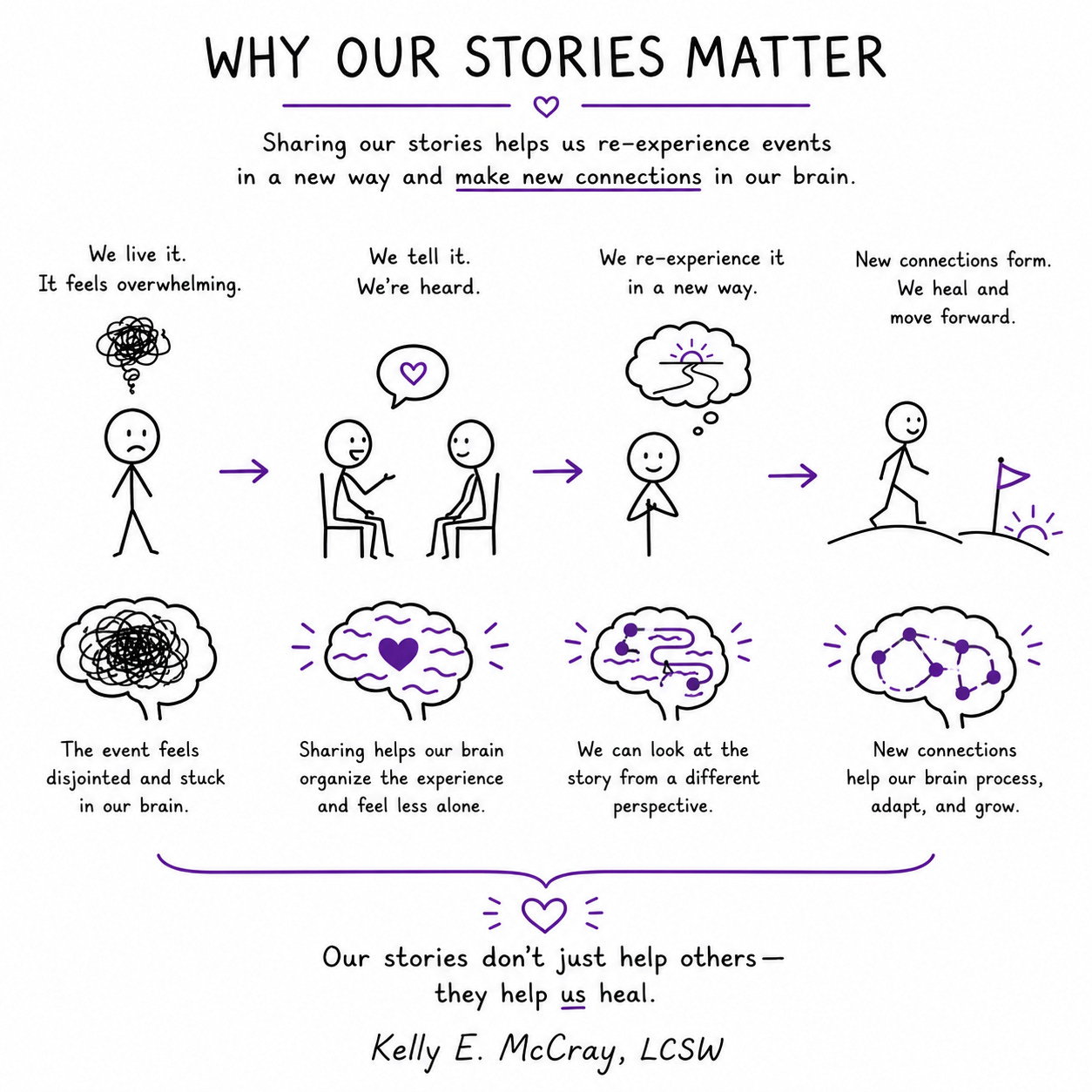
One of the most fascinating findings in neuroscience is that putting experiences into language appears to help connect different regions of the brain involved in memory, emotion, self-awareness, and meaning-making. Experiences that once felt overwhelming or disjointed can begin to feel more organized when we tell the story of them. This doesn’t erase the pain. It doesn’t change what happened. But it does help transform an experience from something that simply happens to us into something we can begin to understand and integrate into our lives.
This is particularly important when it comes to trauma. We often talk about trauma as though it lives in the past, but for many people it doesn’t feel that way. A person may know intellectually that an event occurred years ago, yet their body continues to respond as though the threat is still present. Their heart races. Their muscles tense. Their nervous system prepares for danger. What others perceive as “dwelling on the past” is often a nervous system that has not yet learned that the event is over.
This is why story matters so much. When we begin to tell our stories in safe and meaningful ways, we are doing more than recounting facts. We are helping our brains make sense of experiences that may still feel unfinished. We are creating a bridge between what happened and what it means. We are taking scattered pieces and weaving them into something coherent.
As I think about those testimonies from my childhood, I wonder if this is part of what made them so powerful. People weren’t simply sharing information. They were sharing meaning. They were standing in front of a congregation and saying, “This is what happened to me, this is what I learned, and this is where I found God in the middle of it.” Their stories became evidence that suffering was not the end of the narrative.
Perhaps that is why Scripture places such a strong emphasis on remembering and retelling. The Bible itself is not primarily a collection of abstract principles. It is a collection of stories. Stories of wandering and returning. Stories of failure and redemption. Stories of ordinary people encountering an extraordinary God. Again and again, God’s people are instructed to remember what He has done and tell the next generation about it. Not because God needs the reminder, but because we do.
In a culture that encourages us to curate our lives, there is something quietly radical about telling the truth. Not every story belongs on social media, and wisdom should always guide what we share and with whom. But most of us need trusted spaces where we can stop performing and start being known. We need relationships where we can speak honestly about our disappointments, our grief, our fears, and our hopes without worrying that our humanity will disqualify us from belonging.
I’ve come to believe that healing often begins when we stop asking, “How do I get rid of this story?” and start asking, “How do I make sense of it?” The goal is not to erase the past. The goal is to understand it well enough that it no longer controls the present. As we tell our stories, we discover that we are more than our wounds, more than our mistakes, and more than the hardest chapters we have lived through.
And sometimes, in the process of sharing our own story, we become part of someone else’s healing. They hear their own experience echoed in ours. They realize they are not alone. They find language for something they have never been able to explain. They catch a glimpse of hope where they thought none existed.
Maybe that’s what those testimony services were teaching me all along. God doesn’t just work through miracles. He works through stories. Through ordinary people who are willing to tell the truth about where they’ve been, what they’ve survived, and how grace met them there.
Our Daily Thread is a collaborative space. If you want to be a contributor, we would love to chat with you about it. Subscribe & send us an email at info@iamwellwoven.com!

